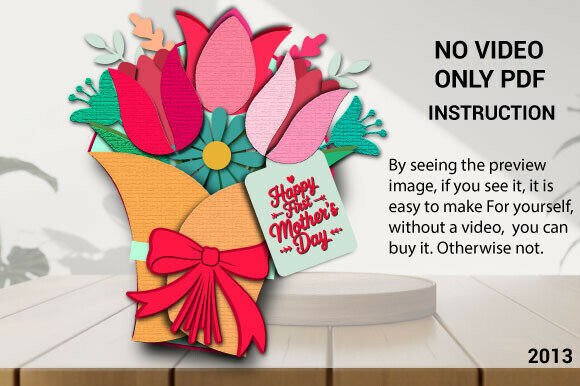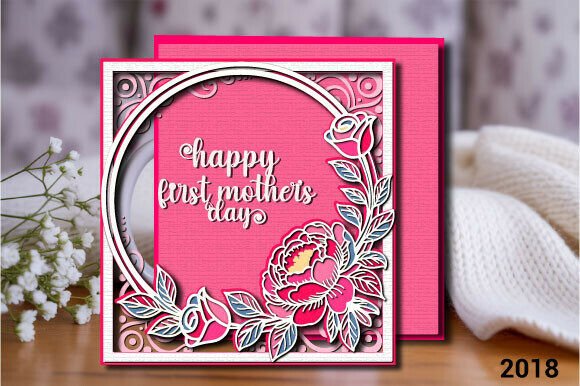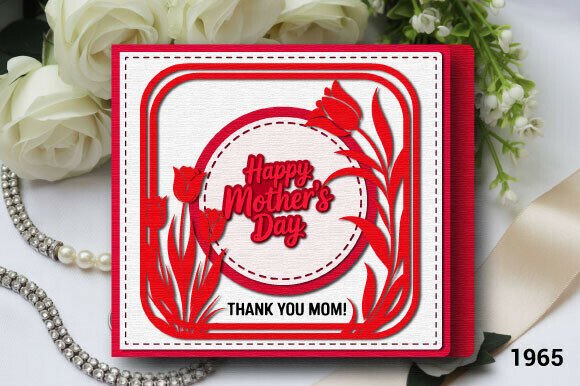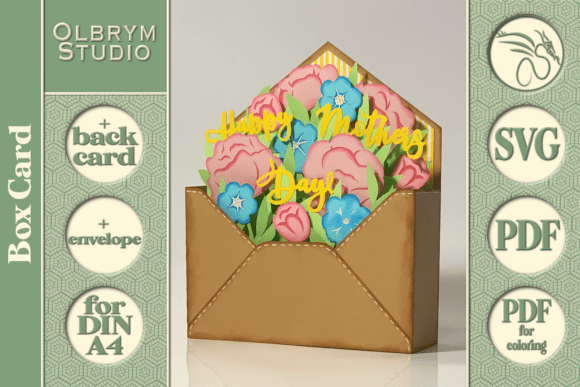
Happy Mother s Day 1 - Drawer Favor Box Review
As a designer who spends countless hours translating digital concepts into tangible stitched goods, I approach every new asset with a critical eye. The market is flooded with generic graphics, but finding a design that bridges the gap between paper crafting and textile art requires a specific set of criteria. Today, I am evaluating the Happy Mother s Day 1 - Drawer Favor Box. While the product description explicitly identifies this as a paper cut template for a 2-part sliding drawer favor box, my job is to determine how its aesthetic principles translate when adapted for embroidery projects or used alongside them in a comprehensive gift suite.
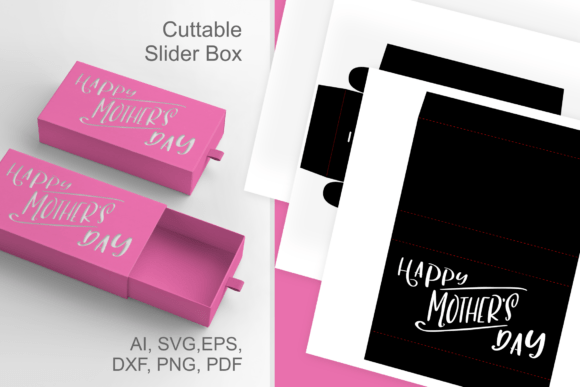
The first impression of the Happy Mother s Day 1 - Drawer Favor Box is one of structured elegance. The layout features decorative text cutouts that suggest a clean, modern typography style rather than the cluttered, script-heavy designs often seen in seasonal collections. For an embroidery designer, this clarity is a significant advantage. When we move from a flat paper template to a textured fabric surface, simplicity often wins. The visual personality here feels professional and timeless, making it a strong candidate for high-end handmade products where the focus is on the message and the craftsmanship rather than overwhelming detail.
Bridging Paper Templates and Textile Art
In a real-world scenario, imagine you are preparing a custom boutique order for a local nursery school's Mother's Day event. You need a cohesive look that includes both a physical favor and a wearable keepsake. The Happy Mother s Day 1 - Drawer Favor Box serves as the perfect packaging anchor. However, to elevate the entire presentation, you might want to create a matching embroidered patch or a small tote bag design that mirrors the sentiment of the box.
Because the original design relies on "decorative text cutouts," adapting this for a machine embroidery design requires careful consideration of stitch types. If you were to digitize the text elements from this concept, you would likely lean heavily on satin stitch for the lettering to ensure crisp edges, while using a dense fill stitch for any background shapes. The challenge lies in maintaining the "3D" feel mentioned in the product category. In paper, depth is created by layers; in embroidery, depth is achieved through layering stitches and varying thread weights. A savvy Etsy seller could use the box as the primary vessel for treats and pair it with a small, embroidered card or tag that uses the same font style, creating a unified brand experience for their customers.
Performance in Real-Life Embroidery Situations
When considering how the aesthetic of the Happy Mother s Day 1 - Drawer Favor Box performs across different mediums, the versatility becomes apparent. For custom apparel, such as a premium sweatshirt or a canvas tote bag, the clean lines of the text allow for larger hoop sizes without losing legibility. This is crucial for commercial embroidery where consistency across hundreds of items is non-negotiable. If you are producing a batch of aprons for a cooking class celebrating mothers, the bold nature of the design ensures it remains visible even from a distance.
However, the transition from a paper template to a digital embroidery file is not automatic. The intricate cutouts described in the box design might become problematic if scaled down too much for a baby onesie or a cap. On curved surfaces like caps, the tension of the fabric can distort wide text. Therefore, while the concept works beautifully for flat applications like pillow covers or tea towels, it requires modification for smaller, contoured items. A personalized gift strategy would involve keeping the embroidery simple—perhaps just the phrase "Happy Mother's Day"—and letting the actual Drawer Favor Box handle the complex decorative elements.
Design Constraints and Fabric Considerations
Every designer knows that context dictates execution. There are specific areas where the design language of the Happy Mother s Day 1 - Drawer Favor Box should be used with caution. If you attempt to replicate the detailed cutouts on thin or stretchy fabrics, the risk of puckering increases significantly. The density required to mimic the solid shapes of a paper cutout can overwhelm delicate materials like chiffon or lightweight cotton jersey.
Furthermore, consider the issue of stitch density. If you try to fill the negative spaces of the decorative text with heavy fill stitches, the resulting embroidery might become stiff, compromising the drape of a garment. This is particularly important for holiday gifts that will be worn frequently. Additionally, on dark fabrics, light-colored thread is essential for contrast, but the intricate details might get lost if the thread colors are not chosen carefully. Always test the design on scrap fabric first to see how the texture interacts with the pattern. A printable mockup is useful, but nothing replaces the tactile reality of stitching on the actual material.
Impact on Brand Value and Customer Trust
For a small shop product or a craft business owner, the perceived value of your finished product is directly linked to the quality of your design assets. Using a cohesive theme like the Happy Mother s Day 1 - Drawer Favor Box alongside well-executed embroidery signals professionalism. It tells the customer that you have thought about the unboxing experience as a whole. When a buyer receives a sturdy, beautifully designed favor box paired with a high-quality embroidered item, their trust in your brand skyrockets.
This attention to detail enhances the giftability of your items. In the competitive world of handmade goods, presentation is everything. The finished product should feel curated, not just assembled. By aligning your embroidery style with the clean, modern vibe of the drawer box, you create a narrative of care and precision. This is especially vital for commercial embroidery clients who need their merchandise to reflect a polished image.
Practical Notes for Designers and Makers
Before integrating this concept into your workflow, there are several practical steps to take. First, verify the licensing terms. Since the Happy Mother s Day 1 - Drawer Favor Box is described as a paper cut template, ensure you have the rights to adapt the imagery for commercial embroidery if you plan to sell the stitched goods. Do not assume the license for a digital download includes derivative textile work.
Second, always check your hoop size requirements. If you are creating a companion design, ensure the dimensions fit within your machine's capabilities without requiring awkward re-hooping. Third, pay close attention to stabilizer choices. For designs with dense text or filled areas, a tear-away or cut-away stabilizer is necessary to prevent distortion. Finally, compare your design against light and dark fabric backgrounds in your software before committing to production. The contrast that looks great on a white screen might fail on a navy blue sweatshirt.
Ultimately, the Happy Mother s Day 1 - Drawer Favor Box offers a strong foundation for a creative project. Whether you are a hobbyist looking to make a special gift or a seasoned embroidery designer scaling up for a boutique line, understanding how to translate these paper-based aesthetics into textile form is key. By respecting the limitations of the medium and leveraging the strengths of the design, you can create handmade products that truly stand out this season.